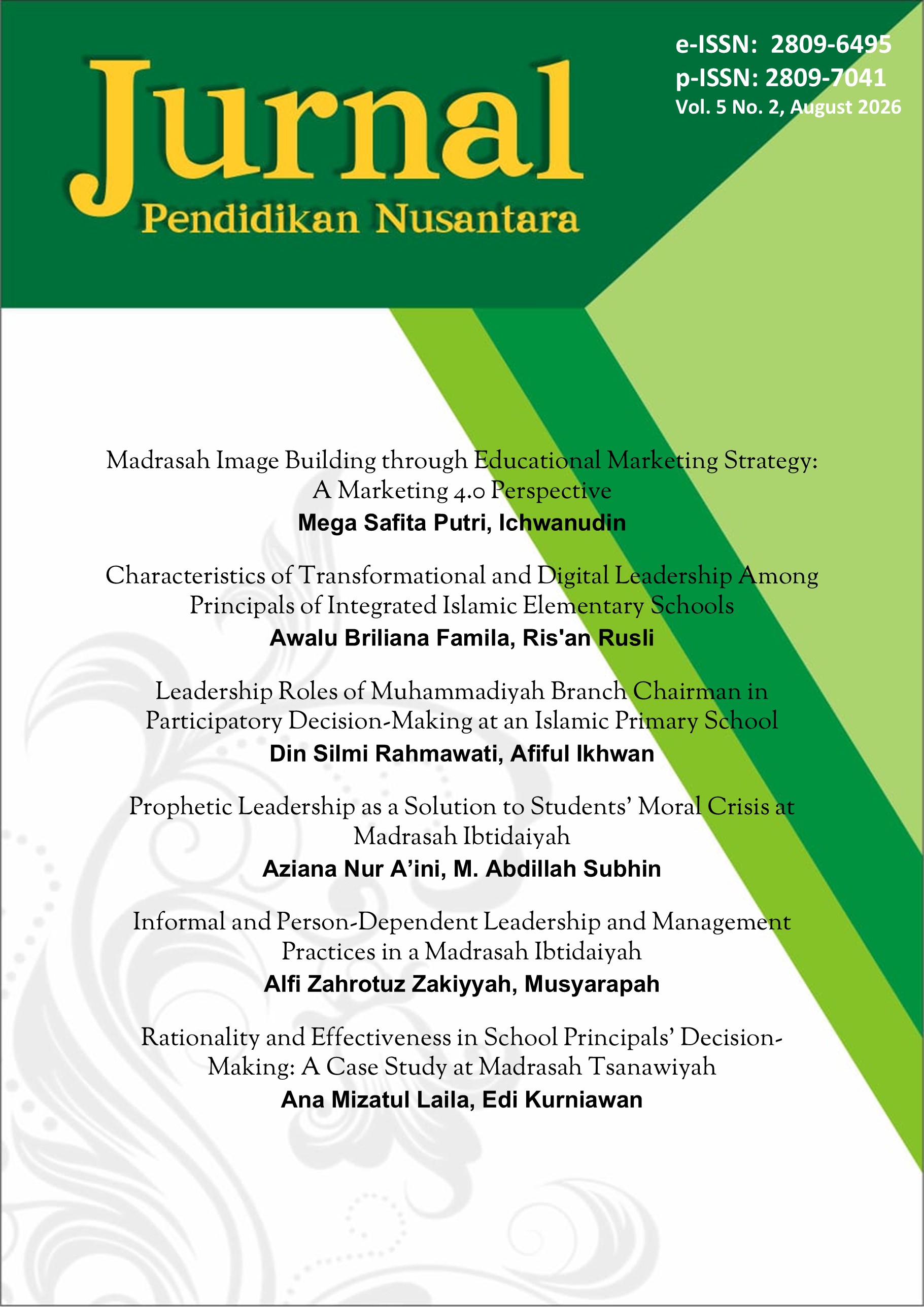
Prophetic Leadership as a Solution to Students’ Moral Crisis at Madrasah Ibtidaiyah
DOI:
https://doi.org/10.55080/jpn.v5i2.229Keywords:
Prophetic Leadership, Moral Crisis, UkhrawiAbstract
This study aims to examine the moral crisis in contemporary leadership that is marked by a weak ukhrawi orientation, to describe the implementation of prophetic leadership at MI Sabilul Muhtadin, and to analyze its impact on students’ moral development. A descriptive qualitative method was used. Data were collected through one-day observation, an interview with one teacher, and a literature review, and were analyzed using the interactive model of (data reduction, data display, and conclusion drawing). The findings show that prophetic leadership based on the values of siddiq, amanah, tabligh, and fathanah was implemented through the Habituation of responsibility, deliberation, kindness projects, empathy, and Dhuha prayer, which had a positive impact on students' discipline, responsibility, and spiritual awareness. It is concluded that prophetic leadership implemented through consistent Habituation is a promising solution to students' moral crisis at the Madrasah Ibtidaiyah level, although further research with more informants and longer observation is needed.
Downloads
References
Abdul Basith, F., Hilman Rasyid, Euis Erha Rohmah, Aan Hasanah, & Bambang Samsul Arifin. (2025). The Urgency of Character Education Based on Prophetic Pedagogy: An Approach to Overcoming Students’ Moral Crisis. Journal of Education and Social Culture, 1(1), 69–79. https://doi.org/10.58363/jesc.v1i1.15
Aminuddin, M. Y. (2024). Prophetic Leadership: Revitalisasi Kepemimpinan Profetik Diera Society 5.0 Dalam Bingkai Nasionalisme. TA’LIM: Jurnal Studi Pendidikan Islam, 7(1), 36–59. https://doi.org/10.52166/talim.v7i1.5074
Arif, M. (2021). Prophetic Leadership in Forming the Religious Moderation Values in Islamic Education Institutions. Cendekia: Jurnal Kependidikan Dan Kemasyarakatan, 19(2), 219–235. https://doi.org/10.21154/cendekia.v19i2.3109
Budiyanti, N., & Parhan, M. (2024). Evaluating the Ulul Ilmi Model: Enhancing Spiritual and Moral Character through Holistic Islamic Pedagogy in Higher Education. Jurnal Pendidikan Islam, 13(1), 55–68. https://doi.org/10.14421/jpi.2024.131.55-68
Dian, D., Banyu Asih, D., Sri Mulyani, E. K., Putri, S., & Fahmi Nusyeha, M. I. (2025). Strategic Management of Character Education: A Holistic Model for Fostering Socio-Religious Attitudes in an Islamic Elementary School in Indonesia. EDUKASI: Jurnal Penelitian Pendidikan Agama Dan Keagamaan, 23(3), 658–673. https://doi.org/10.32729/edukasi.v23i3.2264
Gusliana, E. (2025). Konsep Kepemimpinan Profetik dalam Manajemen Pendidikan Islam. Quantum Edukatif: Jurnal Pendidikan Multidisiplin, 2(2). https://synergizejournal.org/index.php/QE/article/view/185
Hasan, M. A., & Malik, M. H. (2025). The Criteria and Ethics of Educational Leadership in the Perspective of the Qur’an. Journal of Educational Sciences, 9(2), 876–885. https://doi.org/10.31258/jes.6.3.p.444-458
Ma`arif, M. A., Muqorrobin, F. M., Kartiko, A., Sirojuddin, A., & Rofiq, A. (2024). Developing Islamic Character Values Through Student Habituation. Al-Hayat: Journal of Islamic Education, 8(1), 337. https://doi.org/10.35723/ajie.v8i1.501
Miles, M. B., Huberman, A. M., & Saldaña, J. (2014). Qualitative Data Analysis: A Methods Sourcebook. SAGE Publications.
Minhaji, M., Akhsan, A., Mahmudi, M., Supriadi, S., Rif’ah, R., & Nurainun, N. (2025). Revisiting Michael C. Jensen’s Three Principles for Great Leadership: A Critical Appraisal in Islamic Educational Leadership. Mimbar Agama Budaya, 42(2), 446–458. https://doi.org/10.15408/mimbar.v42i2.47055
Muntholib, M. (2018). Islamic Education Leadership Morality. Al-Hayat: Journal of Islamic Education (AJIE), 2(2). https://doi.org/10.35723/ajie.v2i2.38
Pamungkas, S. D., & Ichwanudin, I. (2025). Integration of Sapta Jiwa Value in Prophetic Leadership to Improve Santri Character Education in Islamic Boarding Schools. Jurnal Pendidikan Nusantara, 4(1), 12–25. https://doi.org/10.55080/jpn.v4i1.176
Piwowar-Sulej, K., & Iqbal, Q. (2024). A systematic literature review on spiritual leadership: antecedents, mechanism, moderators and outcomes. Journal of Organizational Change Management, 37(8), 18–35. https://doi.org/10.1108/JOCM-11-2023-0483
Rakhman, F., Munardji, M., Hamsinah, H., Ahsan, M., & Liswandi, L. (2023). The Interpersonal Contribution of Capital Prophetic Leadership of Principals in Character Development. Al-Hayat: Journal of Islamic Education, 7(2), 479. https://doi.org/10.35723/ajie.v7i2.428
Rouf, M. (2022). Kepemimpinan Moral dalam Pendidikan Islam; Telaah Model Spiritual dan Profetik. Jurnal Kajian Islam Al Kamal, 2(2), 421–433. https://ejournal.staika.ac.id/index.php/alkamal/article/view/31
Siregar, K. I., Syam, A. R., & Alif, M. (2026). Glocalizing Islamic Education: Prophetic Hadith Values and Educational Transformation in a Contemporary Pesantren. Al-Hayat: Journal of Islamic Education, 10(2), 397–413. https://doi.org/10.35723/ajie.v10i2.309
Wang, Y., Li, Y., Meng, H., & Kong, S. (2024). Injustice Promotes Unethical Behavior Through Moral Disengagement. Basic and Applied Social Psychology, 46(1), 7–18. https://doi.org/10.1080/01973533.2023.2275070
Weißmüller, K. S., & Ritz, A. (2026). A Demands-Resources Model of Corruptibility: Empirical Evidence on How Moral Disengagement and Harm Awareness Regulate Civil Servants’ Moral Judgment. Review of Public Personnel Administration. https://doi.org/10.1177/0734371X261417649
Yulianti, H. (2024). Manajemen Kesiswaan: Program Sholat Dhuha Dalam Memperkuat Spiritualitas Siswa. Jawda: Journal of Islamic Education Management, 5(1). https://doi.org/10.21580/jawda.v0i0.0.21370
Downloads
Published
How to Cite
Issue
Section
License
Copyright (c) 2026 Aziana Nur A’ini, M. Abdillah Subhin

This work is licensed under a Creative Commons Attribution 4.0 International License.