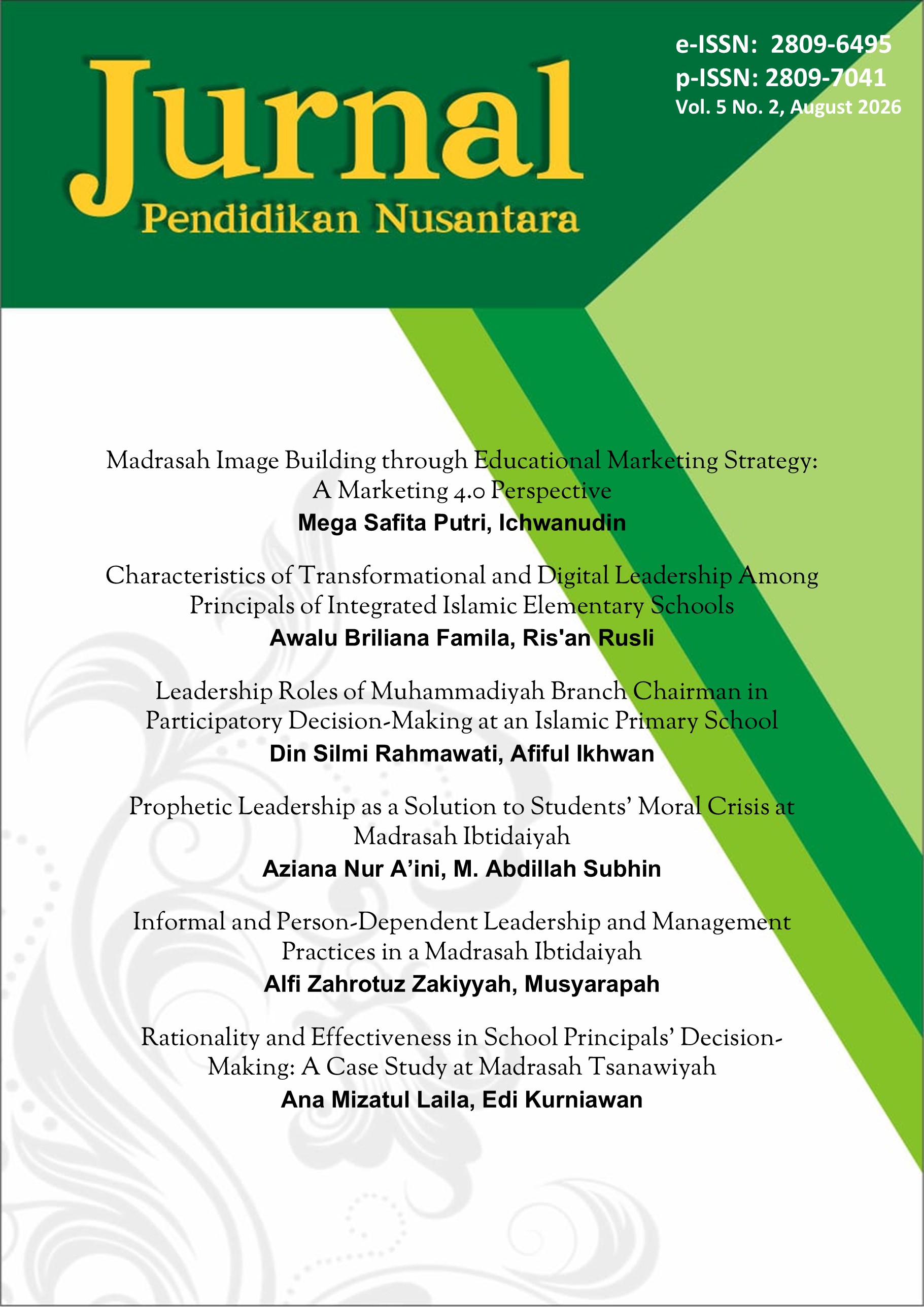
Leadership Roles of Muhammadiyah Branch Chairman in Participatory Decision-Making at an Islamic Primary School
DOI:
https://doi.org/10.55080/jpn.v5i2.230Keywords:
Leadership, Chairman of the Muhammadiyah Branch, Decision-MakingAbstract
This study aims to analyse the role of the Chair of the Muhammadiyah Branch in leadership and decision-making processes at MI Muhammadiyah 10 Yanggong, as well as identifying the challenges faced in its implementation. The study used a qualitative approach with a descriptive method. The participants in the study consisted of the Chairman of the Muhammadiyah Branch as the main informant, the head teacher, and the branch committee members as supporting informants. Data were collected through observation over one week and in-depth interviews over three days. The data were analysed using thematic analysis, through the stages of data reduction, data presentation, and drawing conclusions. The results of the study show that the Chairman of the Muhammadiyah Association has a role as a mentor, guide, facilitator and liaison between the Muhammadiyah Association and the school. Decision-making processes were carried out through consultations involving the head teacher, teachers, and the branch committee. The obstacles encountered included differences in opinion, limited time for coordination, and suboptimal communication. The participatory leadership model implemented helped to create good cooperation and support the successful management of the educational institution.
Downloads
References
Afifa, U. K. (2026). Integrated Islamic School Management: Leaders’ Policies and Stakeholders’ Responses. Social Criticism of Islamic Studies, 1(1), 41–55. https://doi.org/10.35723/scis.v1i1.10
Akhmad, A. (2025). Digital Leadership Practices in Educational Management: A Narrative Literature Review on Trends and Challenges. International Journal of Learning, Teaching and Educational Research, 24(8), 112–135. https://doi.org/10.26803/ijlter.24.8.6
Alecida, C. L. G., Trases, E. P., & Escarlos, G. S. (2025). The Evolving Landscape of Educational Management : A Systematic Review of Instructional and Distributed Leadership Frameworks. IX(2454), 4471–4476. https://doi.org/10.47772/IJRISS
Ambuehl, B., Kunwar, B. M., Schertenleib, A., Marks, S. J., & Inauen, J. (2022). Can participation promote psychological ownership of a shared resource? An intervention study of community-based safe water infrastructure. Journal of Environmental Psychology, 81(September 2021), 101818. https://doi.org/10.1016/j.jenvp.2022.101818
Berkovich, I., & Hassan, T. (2025). Principals’ digital transformational leadership, teachers’ commitment, and school effectiveness. Education Inquiry, 16(2), 177–194. https://doi.org/10.1080/20004508.2023.2173705
Bush, T. (2024). School leadership and student outcomes : What do we know ? 52(1), 3–5. https://doi.org/10.1177/17411432231210364
Caharian, I. S., & Cabanlit, E. M. (2024). A Systematic Review on the Influence of Transformational Leadership and Teacher Commitment to Educational Institutions. International Jurnal of Reseach and Innovation in Social Science, VIII(IX), 1175–1189. https://doi.org/10.47772/IJRISS.2024.809006
Dewi, T., & Abidin, U. K. (2023). Transformasi Pendidikan: Peran Strategis Kepala Sekolah dalam Membangun Peserta Didik Berkualitas. Jurnal Pendidikan Nusantara, 2(2), 144–155. https://doi.org/10.55080/jpn.v2i2.132
Earlyanti, N. I. (2024). The Role of Innovative Leadership in Driving Educational Management Transformation. 16(1), 207–218. https://doi.org/10.37680/qalamuna.v16i1.4745
Fadhli, F., Komariah, A., Satori, D., & Marwan, M. (2025). “ Clear vision , better schools ”: The role of instructional leadership in enhancing service quality. Journal of Educational Management and Instruction, 5(1), 161–174. https://doi.org/10.22515/jemin.v5i1.9507
Grogan, M. (2024). Editorial : Insights in leadership in education : 2022. Frontiers in Education, 9. https://doi.org/10.3389/feduc.2024.1372208
Hallinger, P., Liu, S., & Chen, L. (2025). Principal Instructional Leadership and Teacher Attitudes: A Meta-Analytic Review, 1989–2024. European Journal of Education, 60(4). https://doi.org/10.1111/ejed.70199
Hamami, T., & Zalik Nuryana. (2022). A holistic – integrative approach of the Muhammadiyah education system in Indonesia. HTS Teologiese Studies/Theological Studies, 78(4). https://doi.org/10.4102/hts.v78i4.7607
Haryaka, U., Mulawarman, W. G., Nurlali, N., Warman, W., Sjamsir, H., & Sa’ad, M. I. (2026). Transformational leadership in educational management: encouraging student motivation and engagement. Frontiers in Education, 11. https://doi.org/10.3389/feduc.2026.1676318
Hestiana, R., & Labaso, S. (2024). Budaya Organisasi Lembaga Pendidikan Islam dalam Epistemologi Kuntowijoyo. Jurnal Pendidikan Madrasah, 9(1), 97–108. https://doi.org/10.14421/jpm.2024.97-108
Hidayah, T. N. S., & Kosasih, A. (2025). The Transformation of Islamic Education to Strengthen the Morals and Ethics of 21st Century Students. Jurnal Pendidikan Nusantara, 4(2), 102–112. https://doi.org/10.55080/jpn.v4i2.190
Isnaini, A. (2026). Dynamics of Student Religious Character Formation through Islamic Religious Education Learning. Journal of Islamic Education, 11(2), 408–422. https://doi.org/10.35723/jie.v11i2.738
Jakandar, L. I. E., Pantiwati, Y., Sunaryo, H., & Fikriah, A. (2025). Integration of Religious Values in Character Education : Building the Morals of the Golden Generation. Al-Hayat: Journal of Islamic Education, 9(1). https://doi.org/10.35723/ajie.v9i1.107
Jannah, A., Harahap, I. M., & Maidiana, M. (2024). Peran Pemimpin dalam Pengambilan Keputusan. Al-Tarbiyah: Jurnal Ilmu Pendidikan Islam, 2(2), 37–43. https://doi.org/10.59059/al-tarbiyah.v2i2.857
Jemain, Z., Kholid, I., Djazuli, A., & Subandi, S. (2025). Integration of Learning Organization Principles in Muhammadiyah Education: A Case Study of Elementary and Middle Schools in Palembang, Indonesia. AL-ISHLAH: Jurnal Pendidikan, 17(2), 3102–3113. https://doi.org/10.35445/alishlah.v17i2.7446
Kareem, J., Patrick, H. A., & Prabakaran, N. (2025). Exploring the factors of learning organization in school education: the role of leadership styles, personal commitment, and organizational culture. Central European Management Journal, 33(2), 232–251. https://doi.org/10.1108/CEMJ-12-2023-0457
Kareem, J., Patrick, H. A., Prabakaran, N., Valarmathi, B., Tantia, V., Pramod Kumar, M. P. M., & Mukherjee, U. (2023). Transformational educational leaders inspire school educators’ commitment. Frontiers in Education, 8(May). https://doi.org/10.3389/feduc.2023.1171513
Lestari, S. (2024). Strategi Pengambilan Keputusan Dalam Kepemimpinan Pendidikan Islam. Jurnal Wahana Pendidikan, 11(2), 279–294. https://doi.org/10.25157/jwp.v11i2.11864
Miles, M. B., Huberman, A. M., & Saldana, J. (2015). Qualitative Data Analyzis: A Method Sourcebook.
Mukhtar, S., Razak, A. Z. A., Setiyowati, N., & Adni, M. A. (2025). Educational leadership innovation : a recent comprehensive structured review. 19(4), 2342–2350. https://doi.org/10.11591/edulearn.v19i4.23239
Novezar, R. A., & Ridho, M. R. (2024). Transformational Leadership of School Principals At The Muhammadiyah Junior High School Level In Wonosobo Regency. Ittishal Educational Research Journal, 5(1), 1–15. https://doi.org/10.51425/ierj.v5i1.61
Paredes-Saavedra, M., Vallejos, M., Huancahuire-Vega, S., Morales-García, W. C., & Geraldo-Campos, L. A. (2024). Work Team Effectiveness: Importance of Organizational Culture, Work Climate, Leadership, Creative Synergy, and Emotional Intelligence in University Employees. Administrative Sciences, 14(11). https://doi.org/10.3390/admsci14110280
Pimpinan Pusat Muhammadiyah. (2019). Anggaran Rumah Tangga Muhammadiyah. https://muhammadiyah.or.id/anggaran-rumah-tangga
Rahmatia, A., Fauziah, K., Agus, K., Khoir, I., & Noviani, D. (2023). Pengertian : Jurnal Pendidikan Indonesia ( PJPI ). https://doi.org/10.00000/pjpi.v1n22023
Ramadhani, N., & Anwar, S. (2026). Jurnal Tujuan Pendidikan Islam dalam Membentuk generasi Berakhlak Mulia. Pojok Guru Jurnal Keguruan Dan Ilmu Pendidikan, 4(1), 82–98.
Rusiana, I., & Muhayat, I. (2026). The Application of Educational Administration Functions in Improving the Quality of Elementary Schools. Jurnal Pendidikan Nusantara, 5(1), 14–22. https://doi.org/10.55080/jpn.v5i1.222
Shiddiq, A. B., Chaerany, C., Fitriyah, N., Wijayanti, R., Azzahra, S., & Kusumaningrum, H. (2024). Evaluasi Program Sekolah Adiwiyata dengan Goal Oriented Evaluation Model di SMPN 12 Tangerang Selatan. Jurnal Ilmu Pemerintahan Dan Administrasi Publik, 2(2). https://journal.wiyatapublisher.or.id/index.php/kybernology
Siddiquei, A. N., Fisher, C. D., & Hrivnak, G. A. (2022). Temporal leadership, team processes, and project team task performance. International Journal of Project Management, 40(7), 715–724. https://doi.org/10.1016/j.ijproman.2022.08.005
Suyatno, S., Wantini, W., Ahmadong, A., Khosiin, K., & Samaalee, A. (2023). Internalization of Islamic Values in Muhammadiyah Elementary Schools. International Journal of Educational Management and Innovation, 4(1), 1–13. https://doi.org/10.12928/ijemi.v4i1.6847
Taherdoost, H., & Madanchian, M. (2024). Decision Making : Models , Processes , Techniques. 5(1), 1–14.
Welsh, R., Williams, S., Bryant, K., & Berry, J. (2021). Conceptualization and challenges: examining district and school leadership and schools as learning organizations. Learning Organization, 28(4), 367–382. https://doi.org/10.1108/TLO-05-2020-0093
Downloads
Published
How to Cite
Issue
Section
License
Copyright (c) 2026 Din Silmi Rahmawati, Afiful Ikhwan

This work is licensed under a Creative Commons Attribution 4.0 International License.