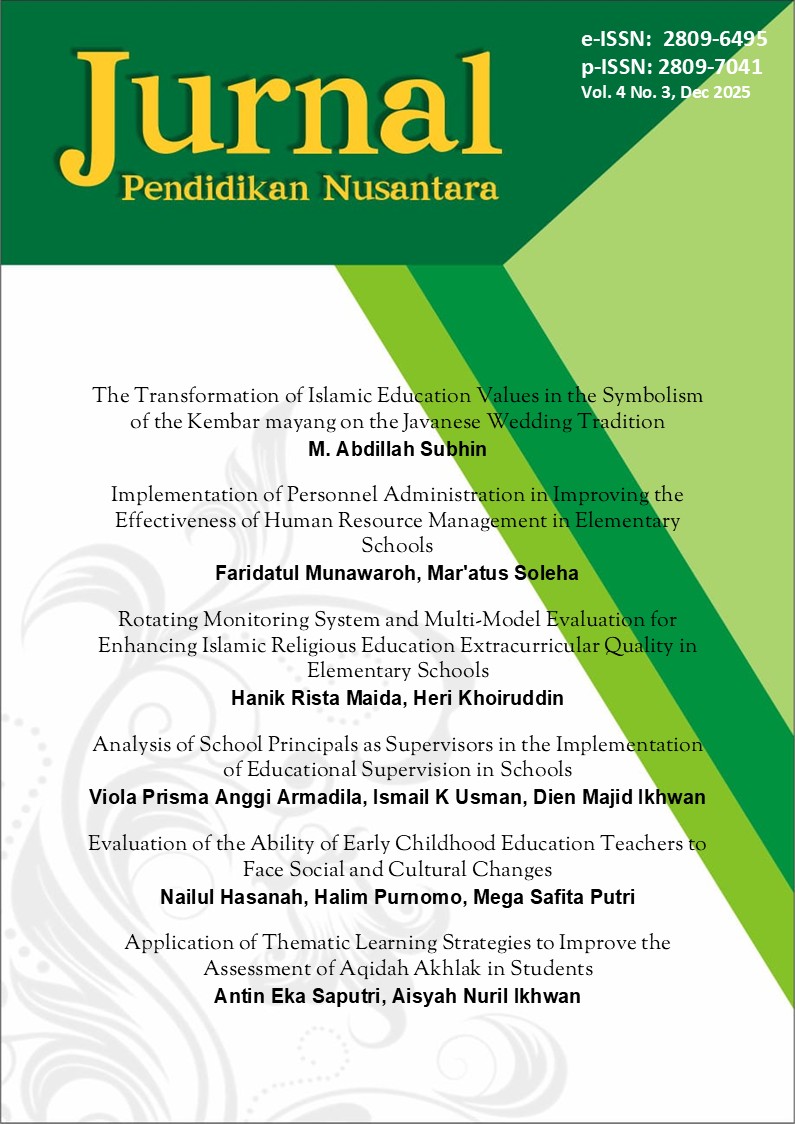
The Transformation of Islamic Education Values in the Symbolism of the Kembar mayang on the Javanese Wedding Tradition
DOI:
https://doi.org/10.55080/jpn.v4i3.202Keywords:
Kembar mayang, Ricoeur Hermeneutics, Al-Ghazali Morals, Islamic Education, Javanese TraditionAbstract
This study aims to interpret the symbolism of twins in Javanese marriage traditions and uncover their relevance to Islamic education. Kembar mayang, which is traditionally interpreted as a symbol of harmony, fertility, and balance, is often seen only as a traditional ornament. Previous research tends to stop at anthropological studies without attributing this symbolism to Islamic education. Through a qualitative approach with a hermeneutical ethnography, this study explores data from PAI teachers, scholars, traditional leaders, communities, and students in Tulungagung with interview, observation, and documentation techniques. Data analysis was carried out using the Miles & Huberman model combined with Paul Ricoeur's hermeneutics. The results of the study found that the mayang twins are still preserved in about 65% of Javanese traditional wedding processions and are understood by the community as an Islamic prayer that includes the values of monotheism, morality, gratitude, tazkiyah al-nafs, and ukhuwah. PAI teachers use it as a medium for moral learning, scholars interpret it as family prayers of sakinah, mawaddah, wa rahmah, while the community makes it a means of strengthening friendship. Thus, twins can be transformed into Islamic educational instruments based on local wisdom. In conclusion, the symbolism of the twins is not just a cultural heritage, but a living text that can be reinterpreted with Ricoeur's hermeneutics and Al-Ghazali's moral ethics. This research presents novelty by offering a model of integration of Javanese cultural traditions and Islamic education that is relevant for the formation of the character of the Javanese Muslim generation in the modern era.
Downloads
References
Alavi, H. R. (2010). Al‐Ghazāli on moral education. Journal of Moral Education, December 2014, 37–41. https://doi.org/10.1080/03057240701552810
Baderiah, B., & Munawir, A. (2024). Harmonizing Local Wisdom with Islamic Values : A Guide to Character Education Development. International Journal of Asian Education, 5(1), 63–75. https://doi.org/10.46966/ijae.v5i1.374
Barrett, N. F. (2023). Religious Symbolism and the Experience of Life as Meaningful : Religions, 14(1). https://doi.org/10.3390/rel14010088
Firdaus, A. M., Thahir, L. S., & Akbar, M. (2023). The Tradition of the Twins Mayang in Javanese Tribe Community Wedding in Sukamaju Village, Banggai District, from the Perspective of Islamic Law. International Journal of Contemporary Islamic Education, 5(1). https://doi.org/10.24239/ijcils.Vol5.Iss1.57
Hidayah, T. N. S., & Kosasih, A. (2025). The Transformation of Islamic Education to Strengthen the Morals and Ethics of 21st Century Students. Jurnal Pendidikan Nusantara, 4(2), 102–112. https://doi.org/10.55080/jpn.v4i2.190
Ichsan, A. S., Khunaivi, H., Al, M. M., & Maulana, A. (2025). Reinterpreting the Values and Symbols of Javanese Character Education for Children in Yogyakarta. Jurnal Studi Pendidikan, 16(1), 24–35. https://doi.org/10.47625/fitrah.v16i1.978
Irsyada, A. E. (2023). Reading the Spiritual Message Behind the Javanese Traditional Wedding Procession. VCD Journal of Visual Communication Design, 08(1), 113–129. https://doi.org/10.37715/vcd.v8i1.3961
Itao, A. D. S. (2010). Paul Ricoeur’s Hermeneutics of Symbols: A Critical Dialectic of Suspicion and Faith. Phil Papers, December, 1–17. https://philpapers.org/rec/ITAPRH-2
Kumara, A. D., Pascasarjana, P., Sosial, A., Medan, U. N., Kumara, A. D., Conference, P. N., Service, C., & Indonesia, S. (2025). Kembar Mayang: Simbol Harapan dan Doa dalam Pernikahan Etnis Jawa di Desa Denai Lama. Proceeding National Conference Of Research And Community Service Sisi Indonesia, 1(1). https://doi.org/10.69836/ncrcs-sinesia.v1i1.26
Mahbubi, M., & Ahmad, A. B. (2025). Navigating the Global and Local : The Intersection of Religious Symbolism in Indonesian Literature and Islamic Modernisation. Titian : Jurnal Ilmu Humaniora, 09(02), 466–478. https://doi.org/10.22437/titian.v9i2.47804
Miles, M. B., Huberman, A. M., & Saldana, J. (2015). Qualitative Data Analysis: A Method Sourcebook.
Mukti, A., Drajat, A., & Kahwash, M. A. M. H. (2021). Moral Education According to Ibn Miskawayh And Al-Ghazali. Jurnal Tarbiyah, 28(1), 56–88. https://doi.org/10.30829/tar.v28i1.972
Putri, R. A., Ondeng, S., & Yahdi, M. (2025). Pendidikan Islam Berbasis Kearifan Lokal : Memperkuat Identitas Budaya Melalui Kurikulum Merdeka. Madani: Jurnal Ilmiah Multidisiplin, 3(1), 1140–1144. https://doi.org/10.5281/zenodo.14712709
Roring, T. A., & Tondok, M. S. (2025). Implementasi Etika Jawa dalam Praktik Kepemimpinan Sekolah Implementations of Javanese Ethics in School Leadership Practices. Jurnal Pendidikan Dan Kebudayaan, 10(1), 89–115. https://doi.org/10.24832/jpnk.v10i1.5873
Sanjani, M. A. F., Zain, B., & Mustofa, M. L. (2024). Islam and Local Wisdom : Integration of Local Values in Islamic Thought. Journal of Social Studies and Education, 02(02), 94–110. https://doi.org/10.61987/jsse.v2i2.567
Sugiyono, D. (2016). Metode Penelitian Kuantitatif, Kualitatif, dan R&D.
Sunarya, I. K., Ismadi, I., Wahyono, W., Dianita, N. K., & Febri, W. N. (2025). Kembar Mayang and Ronce as Motif Ideas in Natural Dye Batik of Keci Beling Leaves and Honey Mango Leaves. De Gruyter. https://doi.org/10.1515/culture-2024-0044
Winarsih, N. (2023). Rewang Tradition : Women Javanese Existences in the Modern Era. Biokultur, 12(1), 21–36. https://doi.org/10.20473/bk.v12i1.45720
Downloads
Published
How to Cite
Issue
Section
License
Copyright (c) 2026 M. Abdillah Subhin Subhin

This work is licensed under a Creative Commons Attribution 4.0 International License.