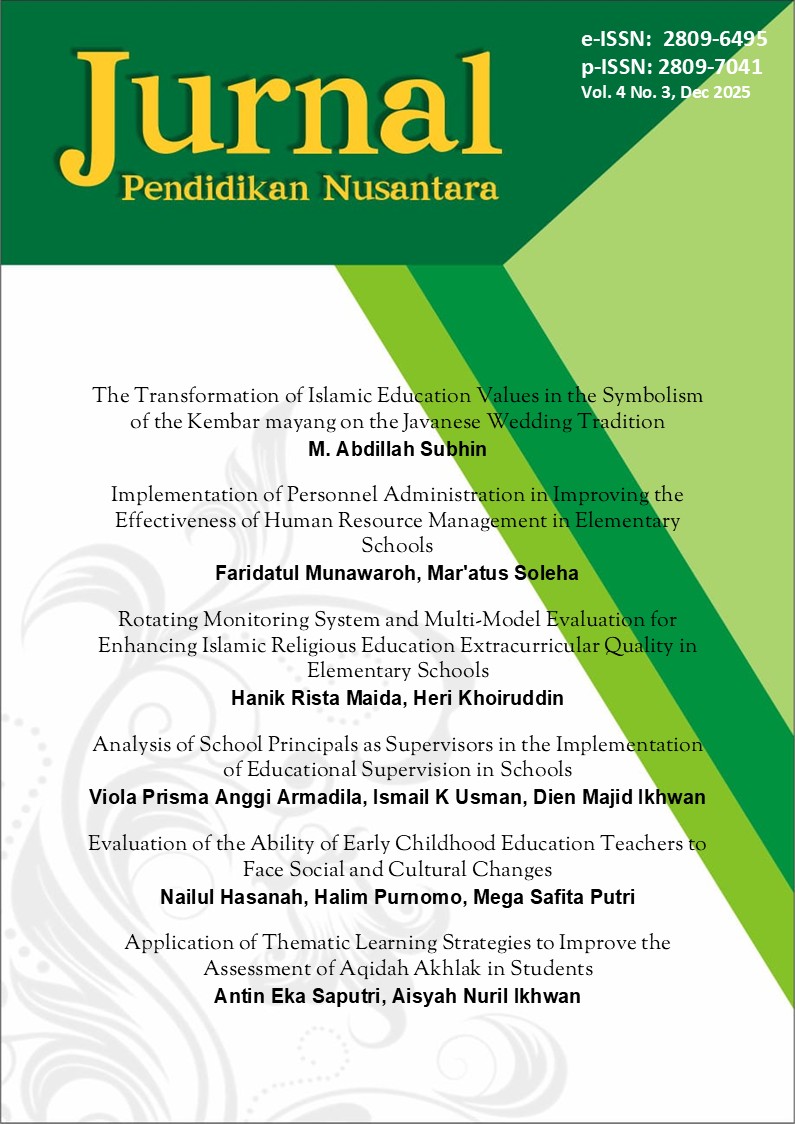
Rotating Monitoring System and Multi-Model Evaluation for Enhancing Islamic Religious Education Extracurricular Quality in Elementary Schools
DOI:
https://doi.org/10.55080/jpn.v4i3.206Keywords:
Monitoring, Evaluation, Religious Extracurricular Activities, Elementary SchoolAbstract
This study aims to comprehensively analyze the implementation of monitoring and evaluation of Islamic Education extracurricular activities at SDN 5 Jurug, Sooko District, Ponorogo Regency, with a focus on: (1) the monitoring procedures applied by Islamic Education teachers in supervising six religious extracurricular programs; (2) the evaluation model used and its effectiveness; (3) supporting and inhibiting factors in the implementation of monitoring and Evaluation. The research used a qualitative approach with a field study method involving one Islamic Education teacher as the main participant. Data collection techniques were carried out through in-depth interviews, participatory observation, and documentation. Data analysis included data reduction, data presentation, and conclusion drawing, with data validity ensured through source and method triangulation. The results of the study show that SDN 5 Jurug implements a two-way monitoring system (directly through teachers on duty with a rotation schedule, and indirectly through attendance records) and implements four evaluation models simultaneously (Summative Evaluation, Goal-Oriented Evaluation Model, Countenance Evaluation Model, and Ten-Step Evaluation Model). The main supporting factors include full support from the principal, availability of adequate facilities, involvement of competent external mentors, and active participation of parents. The identified inhibiting factors are the lack of awareness and commitment of some teachers on duty to the established monitoring schedule. This study concludes that the integration of a rotation monitoring system and multi-model Evaluation has proven effective in improving the quality of religious extracurricular programs. However, improvements are needed in terms of the consistency of supervising teachers' attendance to achieve optimal results.
Downloads
References
Aditya Wijaya, C. (2018). Sistem Monitoring dan Evaluasi Pengelolaan Program Studi di Institusi Pendidikan Tinggi. Indonesian Journal of Information Systems, 1(1), 13–24. https://doi.org/10.24002/ijis.v1i1.1723
Almeida, F., & Morais, J. (2025). Non-formal education as a response to social problems in developing countries. SAGE Open, 22(2), 122–138. https://doi.org/10.1177/20427530241231843
Creswell, J. W., & Creswell, J. D. (2017). Research design: Qualitative, quantitative, and mixed methods approaches. USA: Sage Publications.
Devi, M. Y., Hidayanthi, R., & Fitria, Y. (2022). Model-Model Evaluasi Pendidikan dan Model Sepuluh Langkah dalam Penilaian. Jurnal Basicedu, 6(1), 675–683. https://doi.org/10.31004/basicedu.v6i1.1934
Diaz, C., Tajuddin, N., Deshayes, E., Chelleri, L., Vera, C., Aili, F., & Kapetas, L. (2025). Addressing climate-action implementation gaps in cities : planning for meaningful and consistent implementation through the 5-UP framework. Frontiers in Sustainable Cities, 7(October). https://doi.org/10.3389/frsc.2025.1649194
Fitriani, I. K. (2022). Implementasi Kegiatan Ekstrakurikuler Keagamaan dalam Pembentukan Karakter Religius Peserta Didik di Madrasah Tsanawiyah. Jurnal Basicedu Vol, 6(3), 4612–4621. https://doi.org/10.31004/basicedu.v6i3.2913
Gennari, P. (2025). New international standards and the 2025 comprehensive review of the SDG monitoring framework. Statistical Journal Ofthe IAOS 41(2), 4(2). https://doi.org/10.1177/18747655251342346
Hakkurahmy, B. N. (2023). Evaluasi Program Ekstrakurikuler Keagamaan di Sekolah. Arus Jurnal Pendidikan ( AJUP ), 3(1). https://doi.org/10.57250/ajup.v3i1.209
Hasanah, S. N. (2018). Monitoring dalam Manajemen Sarana dan Prasarana Pendidikan. At-Turats, 12(1), 129–158. https://doi.org/10.24260/at-turats.v12i1.929
Huberman, B. M. M., & Michael, M. (1992). Analisis Data Kualitatif Buku Sumber Tentang Metode-Metode Baru. UIP.
Indana, N., & Mustofa, A. (2024). The Concept of Islamic Education in the Perspective of Imam Al Ghazali and Its Relevance in the Contemporary Era. Urwatul Wutsqo, 13(2). https://doi.org/10.54437/juw
Jasubhai, S. (2025). Personality and Emotional Intelligence : The Role of Extraversion in Self-Control and Managing Emotions among Undergraduate and Postgraduate Students. International Journal of Innovative Science and Research Technology, 10(4). https://doi.org/10.38124/ijisrt/25apr1693
Ketaren, A., Rahman, F., Meliala, H. P., Tarigan, N., & Simanjuntak, R. (2022). Monitoring dan Evaluasi Pemanfaatan Platform Merdeka Mengajar pada Satuan Pendidikan Aswinta. Jurnal Pendidikan Dan Konseling, 4(6), 10340–10343.
Kusumawardani, F. A. (2025). Implementasi Penilaian Afektif pada Mata Pelajaran PAI di SMP Negeri 1 Palimanan Cirebon. Risalah: Jurnal Pendidikan Dan Studi Islam, 11(2), 916–926. https://doi.org/10.31943/jurnal_risalah.v11i2.1381
Leeuwen, A. Van. (2023). Teachers ’ experiences of monitoring their students in online higher education : recommendations for course design and opportunities for learning analytics. Technology, Pedagogy and Education, 32(5), 589–604. https://doi.org/10.1080/1475939X.2023.2254297
Levy-feldman, I. (2025). The Role of Assessment in Improving Education and Promoting Educational Equity. Education Sciences, 15(2). https://doi.org/10.3390/educsci15020224
Magdalena, I., Mulyani, F., Fitriyani, N., & Delvia, A. H. (2020). Konsep Dasar Evaluasi Pembelajaran Sekolah Dasar Di Sd Negeri Bencongan 1. Jurnal Pendidikan Dan Ilmu Sosial, 2(1), 87–98.
Marantika, F., & Fauzi, M. N. (2025). Islamic Education Management Strategy in Improving the Quality of Teaching at MTs Al-Amiriyah. IJGIE Scientific Journal, 6(1), 210–221. https://doi.org/10.37567/ijgie.v6i1.3749
Mubarak, A. F. (2022). Implementasi Monitoring dan Evaluasi Pelaksanaan Supervisi Pembelajaran di Madrasah. Nusantara Journal of Islamic Studies, 3(1). https://doi.org/10.54471/njis.2022.3.1.8-14
Munthe, A. P. (2015). Disampaikan dalam Workshop untuk Mahasiswa tentang Penelitian Metode Kuantitatif dan Kualitatif di Fakultas Ilmu Pendidikan UPH, Karawaci, 16 dan 23 Juni 2015. Scholaria, 5(2), 1–14.
Nasihi, A., & Hapsari, T. A. R. (2022). Monitoring Dan Evaluasi Kebijakan Pendidikan. Indonesian Journal of Teaching and Learning (INTEL), 1(1), 77–88.
Papavasileiou, A., Konteos, G., Kalogiannidis, S., Kalfas, D., & Papadopoulou, C. (2025). Investigating the Impact of Sustainability-Themed Extracurricular Activities on Student Engagement with the 17 SDGs by 2026 : A Case Study of Greece. Sustainability, 17, 1–24. https://doi.org/10.3390/su17073071
Presiden Republik Indonesia. (2005). Standar Nasional Pendidikan dengan Rahmat Tuhan yang Maha Esa. 1–54.
Röhl, S., Bijlsma, H., & Schwichow, M. (2025). Can feedback from students to teachers improve different dimensions of teaching quality in primary and secondary education ? A hierarchical meta ‑ analysis. In Educational Assessment, Evaluation and Accountability (Vol. 37, Issue 1). Springer Netherlands. https://doi.org/10.1007/s11092-024-09450-9
Rohman, T. (2020). Konsep Evaluasi Program Pendidikan Islam. Jurnal Literasiologi, 3(3), 46–57. https://doi.org/10.47783/literasiologi.v3i3.103
Sardiyanah, S. (2020). Konsep Evaluasi Dalam Pendidikan. Jurnal Al-Qalam: Jurnal Kajian Islam & Pendidikan, 8(1), 1–9. https://doi.org/10.47435/al-qalam.v8i1.199
Setiyatna, H., Julijanto, M., Surahman, S., Studi, P., Islam, P., Usia, A., & Syariah, H. E. (2022). JOTE Volume 3 Nomor 2 Tahun 2022 Halaman 200-212 JOURNAL ON TEACHER EDUCATION Research & Learning in Faculty of Education. Journal on Teacher Education, 3(3), 200–212.
Sugiyono, D. (2016). Metode Penelitian Kuantitatif, Kualitatif, dan R&D.
Sumardi, S., Muhaemin, M., & Ilham, D. (2025). From Low Participation to High Engagement : Developing Extracurricular Programs to Optimize Students ’ Talents and Interests. International Journal of Asian Education, 6(3), 266–275. https://doi.org/10.46966/ijae.v6i3.496
Supartini, N., Abdurrahman, A., Winarni, W., & Isnawati, I. (2025). Systematic Literature Review : Teacher Work Motivation and Its Impact on Performance in Elementary Schools. ICEHoS. https://doi.org/10.2991/978-2-38476-450-1
Wafa, M. A., Roziqin, M. K., & Yadha, N. I. (2024). Analisis Pembelajaran PAI Melalui Implementasi Kurikulum Merdeka Belajar di SMPN 1 Kabuh. ISLAMIKA: Jurnal Keislaman Dan Ilmu Pendidikan, 6(3), 951–969. https://doi.org/10.36088/islamika.v6i3.4881
Wijaya, A. (2008). Mengenal Konsep Dasar Evaluasi Pendidikan Pada Pembelajaran. Lentera Kajian Keagaaman, Keilmuan Dan Teknologi, 22(2), 282.
Wityastuti, E. Z., Hidayati, D., & Suardiman, S. P. (2025). The Role 0f School Leadership in Developing Teacher. Journal Visipena, 16(1), 128–139.
Yulianti, W., Tisnawati, L., Teknik, F., Abdurrab, U., Riau Ujung No, J., & Pekanbaru, K. (2020). Sistem Monitoring Dan Evaluasi Tri Dharma Perguruan Tinggi Sebagai Implementasi Penjaminan Mutu Internal Dengan Laravel Dan Rapid Application Development (Rad). JOISIE Journal Of Information System And Informatics Engineering, 4(Desember), 70–76.
Zubaidi, A. (2020). Supervisi, Monitoring, dan Evaluasi Pendidikan dalam Peningkatan Mutu Lembaga Formal dan Non-Formal di Pondok Pesantren Nurul Jadid Paiton Probolinggo. GUYUB: Journal of Community Engagement, 1(2), 143–156. https://doi.org/10.33650/guyub.v1i2.1511
Downloads
Published
How to Cite
Issue
Section
License
Copyright (c) 2026 Hanik Rista Maida, Heri Khoiruddin

This work is licensed under a Creative Commons Attribution 4.0 International License.